Discover Your Authentic Self and Live in Courage, Purpose and Joy

The Mystic Rose Meditation
The Mystic Rose Meditation is longer, more powerful and will take you into a deeper place inside yourself than any of the shorter techniques. It requires a greater committment, not just of your time but of your willingness to dig deep within yourself. The benefits are also much longer lasting and, as they are more deeply rooted within you, will bring a profound transformation on the emotional, physical and mental levels.
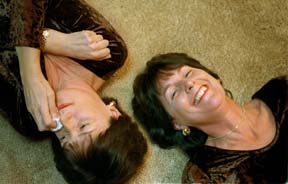 This technique was created by Osho as the second in a series of what he called 'Meditation Therapies'. Because many of us have lost the capacity to sit in silence, these techniques were developed to work as a bridge, to clear the ground for deeper meditation. They are perfect for handling the pressures of our 21st century lifestyle, designed as they were to release us from years of repressed emotions, of physical tensions in the body and old mental ideas and beliefs that no longer work for us. So much energy is tied up in unexpressed emotion. By letting the feelings out, we can then go into deeper and deeper layers, releasing and healing.
They open up our whole energy system, working on the emotional body, doing emotional clearing, releasing stress, pain, anguish, despair. The physical and psychological transformation that can happen through the practice of these techniques creates the potential for more love, more gracefulness, more flexibility and more joyousness in all aspects of our lives.
I chose The Mystic Rose for this book because it is one of the most powerful and simple forms of meditation ever devised. I consider it the greatest revolution in meditation since Vipassana was developed by the Buddha 2500 years ago. It is a three-week process of three hours a day. The first week is for Laughter, for expressing our natural joy and love of life. The laughter week is a great way to open up more to our feelings. The second week is for Crying, for a deep healing and unburdening of the heart. After releasing pent-up emotions through crying, we are ready to simply sit and observe, which is the core of meditation. The third week, which Osho called The Watcher on the Hills, is for sitting silently in deep meditation. It brings about an integration, a closure.
The Mystic Rose is a great technique both for people new to meditation and for experienced meditators.
I recommend drinking a lot of water while doing this technique. When we release tensions from the body, it is a good idea to keep the body well hydrated. I also recommend doing this meditation in a group, and with an instructor, if at all possible. If after trying it out yourself or with a few friends, you find that you'd like to work with an instructor, you can find information on where this meditation is held here, or at www.osho.com. You will also find information about training as an instructor.
If 3 hours a day seems a bit daunting, start with something much simpler, like 5 minutes a day. Then build up to 10 or 15 minutes each day. The important things are that you devote the same amount of time to each stage and that you do the stages in sequence: laughing, crying, watching. Remember, however, that the most powerful benefit will come when you can do 3 hours each day for 3 weeks.
 Stage One: Laughter
Begin by shouting Yaa-Hoo! a few times. Try shouting it with your arms raised over your head. This promotes a feeling of well being and positivity in the body. Many people find they start laughing just from saying "Ya-Hoo!"
Now, sitting or lying down, eyes open or closed, laugh for no reason at all. For 3 hours. If it helps to tell yourself some jokes, or to listen to some taped laughter, that would be a great way to get started. (You can order my CD of laughter here.)
You may prefer to lie on your back. Some people find that this helps relax their stomach muscles and allows energy to move more easily. Some people cover themselves with a sheet, or hold their legs in the air, to help bring out the laughing, giggling child in them. Whatever you need to do to find your inner laughter is fine. If you're doing this with others, some eye contact is also fine.
After 3 hours of laughing, sit silently, watching for 15 minutes. You don't have to become serious, you just want to center your energy before the end of the session.
It's an extraordinary experience to laugh for 3 hours for no reason. I remember the first time I did The Mystic Rose. I was so worried that I wouldn't be able to laugh, especially not for so long. The wonderful thing about laughter is that it brings us to the present moment and when we are in the present moment, worry does not exist. We only worry when the mind takes us to the future or the past. So if you're worried about laughing for 3 hours, just jump in and start laughing and watch as the waves of laughter chase your worry away.
You've probably never just laughed freely like this, so don't be surprised if you come up against some blocks. If you do, try shouting Yaa-Hoo! or do gibberish (nonsense sounds) until laughter arises again. We are all born full of laughter. But our laughter has been repressed by teachers, parents, society. Now in this laughter week you will simply release and reclaim all that dammed up energy.
Here are a few tips to help you get - and stay - laughing:
- Have a lot of cushions in the room, they can be fun to play with.
- If you find yourself not laughing, fake it a little. Start saying, "Ha! Ha! Ha!" or something silly like that. You will undoubtedly find yourself bursting into genuine waves of laughter in relatively short order. If you are still not laughing at this point, keep a smile on your face, keep yourself in an amused feeling and wait for the next wave of laughter. It will come.
- Make a tape of people laughing, or order my laughter CD here, that you can play to help keep the laughter going.
- Do this meditation with a group. Just hearing other people laugh can grease the wheels. If doing this with a group, refrain from talking. Gibberish and sounds are fine, just not words that make sense to the rational mind. You might try sitting back to back with someone, or touch hands or feet. This keeps both of you connected with laughter's infectious vibration. Don't be surprised if you end up in a laughing heap together on the floor.
Try to resist the temptation to compare yourself with anyone, even yourself. (Your laughter will be different from one day to the next.) Try not to judge yourself for not doing it 'right'. All this comparison reflects the anxiety of the mind, which always wants to judge and compare and make sure we are coming out on top. The great thing is, there is no 'right way' to laugh.
After a week, you'll find you have shed many layers of tensions and you'll be extremely relaxed. You will also feel energized, full of aliveness and positivity. You will discover a greater awareness about the comedy that life can be and a new sense of humor about yourself.
 Stage Two: Crying
"The reason people feel better after crying is that they may be removing, in tears, chemicals that build up during emotional stress. Emotional tears have a chemically different content from irritant- induced tears like the ones that appear when we slice onions. Something unique is happening when we cry emotional tears. When we use the expression 'to cry it out', that literally may be true. People do feel better after crying."
Dr. William H. Fry II, "Crying: The Mystery of Tears"
The second week of the Mystic Rose meditation is for crying. For 3 hours each day, you'll just allow yourself to cry and feel your feelings.
Through the crying week, you'll be releasing old wounds and gaining insights and understandings as old memories are allowed to surface. Getting out from under the weight of sorrow that you may have carried around for years can bring deep relaxation.
When I teach this meditation, many men tell me how much they appreciate the chance to relax and be themselves, to show their soft and gentle side. And when men allow themselves to feel, to express tears and sadness and be vulnerable, this promotes healing of issues between men and women. Many couples who go through the process together find it brings greater depth, compassion and understanding to their relationship. Of course, the crying week is also enormously healing for women.
There's not much mystery about the technique, though keeping the room dark can help you move into your sadness. Sitting or lying down, just close your eyes and move deeply into all the feelings that make you cry. Gently open the dam that's been holding all your pent-up feelings, all your sadness and grief. Just let the tears flow out of you. If you feel blocked or get sleepy after crying for a while, try some gibberish. Get into a fetal position and rock your body back and forth a little. Just let the tears come.
After the three hours of crying, sit silently for 15 minutes. Just watch whatever is going on inside and outside.
As you do the crying technique, be careful not to fall asleep or daydream or 'space out'. The mind will try to keep you occupied with other thoughts because it doesn't want to lose control. Remember the mind has learned to control, so letting yourself cry means releasing a lot of old conditioning about controlling yourself and your feelings. This week it's o.k. to not be o.k.
A major key here is acceptance. One of the ways we create psychological pain is by fighting what is happening when the feelings are uncomfortable. The fight creates more pain. If we can find the courage to accept, the pain will heal itself more quickly than if we fight it.
Don't force the tears. Just allow them to happen. Tears are mysterious -- they come on their own. Some days of the crying week you might cry in a flood, others more softly and quietly. Some days you might not cry at all. That's fine; just stay present with your feelings.
Until I started doing the Mystic Rose, and experiencing the crying week, I did not fully understand what had been happening to me through all those years of stuffing my feelings.
I was born and raised in London, England. The emotional environment was stiff upper lip, grin and bear it, have a cup of tea and let's all pretend that everything is fine. The English are masters at repressing emotions and keeping everything 'under control'. I learned quite early that I had to hide, stuff down and control my feelings, and so my childhood was spent largely numbed from emotion. I really don't remember expressing my feelings much at all.
When I first tried the Mystic Rose, I didn't cry much. In fact what came up was anger. After the breakthrough of the Laughter week, I felt that I had spent enough of my life connected to depression, misery and suffering. All I could feel was anger, so I used the crying time to get in touch with the pain that was underneath it. Anger, as I discovered, is aggressive pain. By differentiating anger from pain I was then able to understand and heal myself on a much deeper level.
Another time I wasn't particularly aware of pain, only boredom. By probing a bit, I discovered that allowing and accepting the boredom took me into deeper layers of feelings. Staying with the feelings, the dam did eventually burst and tears just flowed out of me. This was the first time I cried with such compassion and acceptance for myself. With such awareness and consciousness that I was healing myself. It was the first time I consciously took responsibility for my painful feelings instead of blaming others for them.
After doing the crying week, my appearance literally changed. I could see my face, my eyes, jaw, neck and shoulders begin to relax. I looked years younger, healthier, more alive. Instead of hanging onto my sorrows, I found an ability to free myself from the burden of them so that I could open up and allow my soul to sing. This is what the Crying week is about -- freeing ourselves from the burden of old pain. What has been deemed a weakness is in fact one of the most powerful healing forces on earth.
Both laughter and crying release emotional tension; they are two sides of the same coin, but in The Mystic Rose we start with Laughter because it is easier to laugh than to cry. Laughter prepares us to open up; it helps us to move into our hearts so that by day eight we are very ready to cry and to feel. Then, after 7 days of crying, we feel cleansed, opened and deeply relaxed, ready to move into the last stage, where we will integrate the processes of laughing and crying.
 Stage Three: The Watcher On The Hills
This last stage of The Mystic Rose, the Watcher on the Hills, serves as a centering meditation, after all the expression and emotional release. A lot of space has been opened up in you in the past two weeks and you now have an even greater capacity for silence, peace and spiritual nurturing.
For a total of 3 hours each day, you will alternate sitting silently, witnessing your thoughts and emotions, as if you are what Osho called 'a Watcher on the Hills', with short intervals of gentle dancing. You'll need a comfortable place, loose-fitting clothing, and some of your favorite relaxing, soft dance music.
Choose a quiet place where you'll be comfortable and undisturbed. Sitting either on the floor or in a chair, head and back straight but not rigid, with eyes closed, just breathe naturally and relax. Become a witness to whatever is passing by, a 'watcher on the hills'. It doesn't matter what you're watching; it's the process that's the meditation. Try not to become identified with or lost in any particular thoughts or feelings; just watch, witness.
After sitting for 45 minutes, put on some gentle music and dance softly for 15 minutes. Allow your body to find its own movement. Be gentle with yourself but don't get lost in the music. You want to stay aware and continue watching. After 15 minutes, you'll return to sitting. Repeat this 45-minute sitting/15-minute dancing cycle twice more for a total of 3 hours.
The Watcher on the Hills is about awareness, focus and staying awake. You don't do anything, you just relax, but this is an alert relaxedness. In this week, you are practicing disidentification - the capacity to step back and watch. Let yourself be with the moment and watch whatever is happening. Thoughts, feelings, body movements, outside noises -- allow them all to be a part of your awareness without judgment.
We are not used to this doing nothing. This meditation is a way to help us move from doing to being, from out to in. If you become aware that you've spaced out or gotten lost in your thoughts, simply come back to the present moment and go back to watching. No judgments, no comparisons, no goal, simply be.
Any time you feel the need to change position, do it with awareness so that it becomes a part of the meditation. Say to yourself, for example, 'right now I am moving my leg'. Then simply watch the thoughts as they pass by, the emotions as they come and go. The mind and the ego will want to make it complicated, but it is not. It is very simple. Watch, without judgement, and with total acceptance of what is.
And let the mind pass by.
You can imagine yourself as if one would sit high up on a mountain top, watching life pass by with no attachment or involvement.
The first time I did 'The Watcher on the Hills' was also the first time that I sat in a silent meditation for any length of time. Believe me, the thought of being just me with my mind for three hours a day for a week was not an exciting prospect. But, as is so often the case, the reality was a pleasant surprise. I actually found it rather easy to sit and just absorb the changes and insights I'd had over the previous two weeks. The point here is not to close off the mind -- in fact my mind was very active -- but to learn to watch it and to develop the awareness that we are not, in fact, the mind. We can simply observe what goes on in the mind as if from a distance.
Once we reach that place of watcher or witness or observer, we suddenly see ourselves with more clarity and objectivity. We can look at all the dramas in our lives with perspective and compassion.
Sometimes I think of this as gardening, as taking care of the flowers (intuition and inner wisdom) in our inner gardens. In order to nurture the seedlings we must be watchful of weeds (negative, fearful thoughts and judgments) so that the flowers can come to full bloom. We must also be watchful of intruders who might crush and destroy the flowers. When the gardener is home (watching, observing, but not judging) the flowers are safe and can blossom, offering their beauty and fragrance to whoever passes by.
Becoming a Watcher on the Hills frees us from the supremacy of the mind. It allows our inner wisdom full expression, which then creates the very opening we need for the insight and perspective to create our lives just the way we want them to be.
Excerpted from Chapter 9 The Alchemy of love: Going Deeper Lunchtime Enlightenment: Meditations to Transform Your Life NOW-at Work, at Home, at Play